2026 Global Open-source AI Challenge (GOAI)「AI for Research」Track Open for Registration
Empowering AI to Evolve From Research Tool to Scientific Discovery Partner
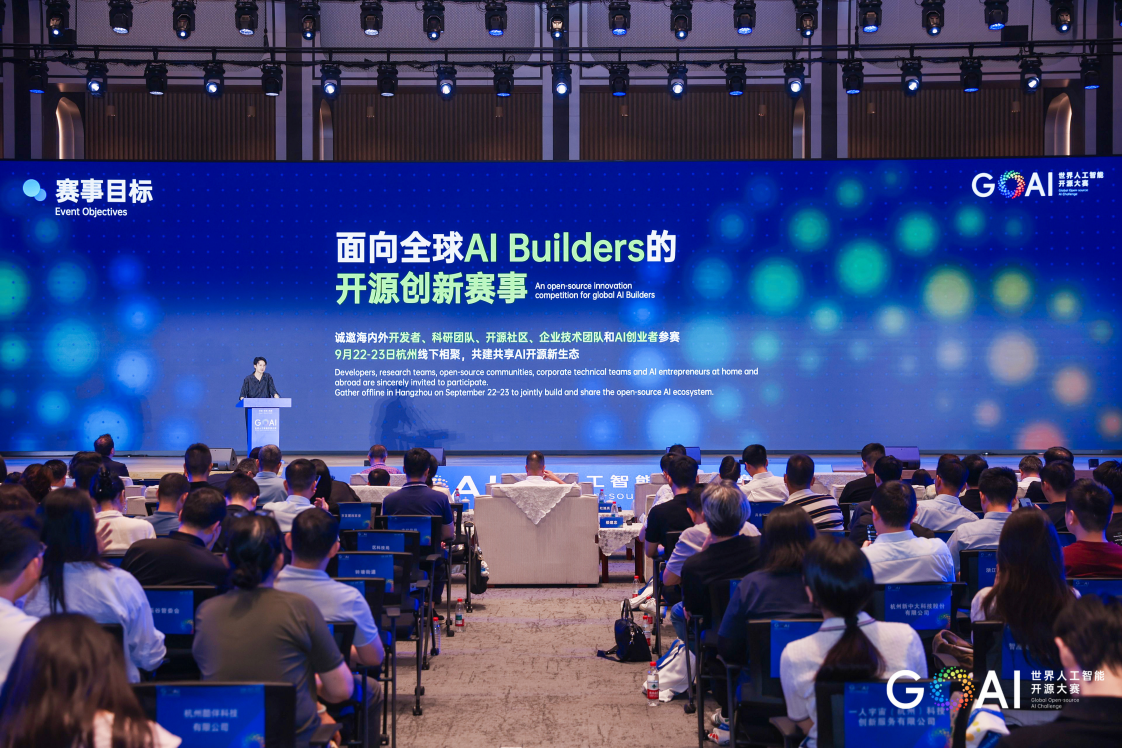
On July 21, 2026, the first Global Open-source AI Challenge (GOAI) officially kicked off at the Hangzhou Cloud Valley Center. As one of the core competition tracks, the AI for Research Track centers on the intersection of AI and scientific research. It sets two categories of challenges: algorithmic challenges and open exploration challenges. Participating teams are encouraged to build operable algorithmic solutions or autonomous exploration environments around real scientific problems, advancing AI as an effective instrument for scientific discovery. This track's challenge sets are jointly developed by research institutions including Datawhale, Westlake University, and Zhejiang University.
At the launch ceremony, guests from academia, industry, open-source communities, universities and developer groups reached a consensus: scientific progress hinges on openness and collaboration. The AI for Research Track aims to integrate AI more deeply into scientific discovery through open-source methodologies.
Track Background: Why the AI for Research Track Matters
Over the past two years, AI has begun to participate deeply in scientific discovery itself. From Lila Sciences' "AI Science Factory" and FutureHouse's Kosmos, which completed six months of research analysis in a single day, to AlphaEvolve's autonomous breakthroughs in mathematics and chip design and Anthropic's Claude Science Workbench, released on June 30, 2026, challenges at the "tool layer" are being systematically addressed.
This indicates that the scarce talent pool no longer consists of people who merely run experiments with AI, but professionals capable of translating scientific intuition into computable exploration environments and redefining "what scientific research looks like in the AI era". This forms the core logic behind the AI for Research Track: scientific research demands not only accelerated computing power, but also the capacity to raise questions, formulate hypotheses, design verification and conduct iterative revisions. This track focuses on how AI can advance from a research assistant to an active participant in scientific discovery.
Track Positioning: Intersection of AI and Science, Two Participation Paths
The AI for Research Track focuses on cross applications of AI and scientific research, offering two separate entry paths: algorithmic challenges and open exploration challenges. Algorithmic challenges cover virtual cells, prediction of small molecule-protein binding trajectories, and scientific discovery agents driven by materials science literature. Teams must build runnable, reproducible algorithmic solutions based on provided datasets and evaluation frameworks, and interpret the scientific significance of their research outputs. Open exploration challenges invite participants to identify authentic, unresolved scientific problems within their own research domains, then convert these problems into environments where Agents can investigate, iterate, revise and conduct continuous exploration.
This track seeks more than teams that simply "operate AI for experiments"; it targets researchers who can translate scientific intuition into computable problems, verifiable signals and sustainable exploration environments.
Core Requirements: A Complete Chain of Evidence, Not Isolated Single Results
In scientific research, a valuable outcome is not merely one that appears correct --- it must also be interpretable, reproducible and subject to further validation. Accordingly, the AI for Research Track places strong emphasis on data, codes, random seeds, runtime environments, experimental logs and benchmark baselines. Together, these form a traceable chain of evidence that enables other researchers to fully trace how a conclusion was derived.
The track also redefines "valuable results": positive discoveries count as achievements, while anomalies, counterexamples, consistent negative results, and even revisions to the original problem definition all serve as meaningful research signals. A "non-discovery" in scientific research does not equal failure if it clarifies the boundary of the research question. Teams are required to predefine discovery signals, instead of retroactively justifying "what constitutes a discovery" after results emerge.
Eligible Participants: Researchers with Dual Expertise in AI and Scientific Disciplines
The AI for Research Track is open to university labs, research institutes, PhD and postdoctoral teams, young researchers worldwide, as well as research groups specializing in computational biology, computational chemistry, computational materials and related fields. Participants may be AI developers proficient in algorithms, models and agent systems, or long-term domain specialists in specific scientific disciplines. You may build upon existing research outputs for further exploration, or develop brand-new algorithmic solutions and autonomous exploration environments based on unresolved scientific questions.
The track especially welcomes cross-disciplinary teams combining AI expertise and domain-specific scientific knowledge. You are not required to train the largest-scale models, but you must demonstrate clear reasoning for the research value of your topic. You do not need to deliver definitive conclusions at the initial stage, yet you must clarify how AI intervenes in research, what qualifies as a discovery, and how results can be validated and reproduced. Teams capable of translating scientific intuition into computable problems, operable environments and verifiable evidence chains are exactly who this track aims to attract.
Participants may register as individuals or form teams. Cross-disciplinary collaboration between researchers specializing in AI, life sciences, chemistry, materials science, physics, mathematics and other fields is highly encouraged. Teams with strengths in algorithm development, experimental design, scientific interpretation, open-source collaboration and research reproducibility will hold competitive advantages. Detailed team formation rules are subject to the official competition website and participant handbook.
Submission Requirements: Separate Submission Paths for Two Challenge Types
The two challenge categories adopt distinct submission paths. For the preliminary round, teams entering algorithmic challenges shall submit solution outlines and technical roadmaps, which may include preliminary experimental results or feasibility verification materials. Teams entering open exploration challenges shall submit a problem definition document of no more than 4 pages, elaborating the research value of the problem, AI intervention methods, construction of exploration environments, definition of discovery signals, and design of minimum benchmark baselines.
Upon advancing to subsequent rounds, algorithmic challenge teams are required to deliver runnable codes, complete experimental results and interpretations of scientific significance. Open exploration challenge teams shall submit a minimum viable exploration environment, full exploration logs, reference baselines including random exploration or trivial solutions, and clear reproducibility documentation. The track evaluates not only final outputs, but also the traceability, interpretability and extensibility of the entire research process.
Teams may utilize commercial APIs or closed-source models, or continue development based on existing projects. However, all calls to external tools, cost assumptions, permission scopes, alternative solutions and their impacts on reproducibility must be fully disclosed. All research data, external resources, open-source dependencies and third-party tools shall include clear notes on the source, authorization status, licensing terms and usage boundaries to ensure all submissions are authentic, transparent and traceable.
Evaluation Criteria: Equal Weight on Scientific Significance and Verifiability
The two challenge categories adopt separate weighted evaluation dimensions as detailed below:
I. Weighting for Algorithmic Challenges:
Technical Performance: 60%
Scientific Significance: 25%
Methodological Innovation: 10%
Openness & Open-source Contribution: 5%
II. Weighting for Open Exploration Challenges:
Quality of Problem Definition & Environment Design: 45%
Exploration Process & Scientific Research Signals: 30%
Inspectability & Extensibility: 20%
Openness & Open-source Contribution: 5%
This weighting framework illustrates that raw scores are not the sole evaluation metric. Judges equally prioritize outputs with clear scientific meaning, reproducible methodologies, and exploration environments that can be packaged as reusable "problem kits" for follow-up researchers. The track pursues not only high benchmark scores, but also novel research questions, original exploration environments and innovative scientific evaluation paradigms.
Schedule & Awards: Progressive Path from Preliminary to Final Rounds
The competition registration opened on July 15. The deadline for preliminary round submissions is August 16; the list of semi-final shortlisted teams will be released on August 24, with the Top 50 teams advancing to the semi-finals; the deadline for semi-final submissions is September 3; the final shortlist will be announced on September 10, and the Top 15 teams will qualify for the finals; offline final defenses and demonstrations will be held on September 22; the award ceremony, project showcase and ecosystem matchmaking will take place on GOAI DAY, September 23. All specific arrangements are subject to the final notice issued by the organizing committee.
In terms of awards, each of the two challenge categories will have one champion, one first runner-up and one second runner-up, with cash prizes of RMB 250,000.00, RMB 150,000.00 and RMB 50,000.00 respectively. Outstanding projects will also stand a chance to compete for the RMB 1,000,000.00 overall GOAI Grand Prize.
Closing Remarks: Empower AI to Raise New Scientific Questions Beyond Answering Existing Ones
The AI for Research Track seeks authentic exploration solutions that demonstrate genuine understanding of scientific problems, rigorous research evidence, reproducibility and open collaboration, rather than superficial "AI + Scientific Research" conceptual packaging.
This track aims to collaborate with global researchers to answer critical questions: Which problems merit computational investigation? What environments support autonomous exploration? What signals constitute valid discoveries? What insights can an unsuccessful trial deliver to guide subsequent research?
When scientific intuition can be converted into operable exploration environments; when positive outcomes, anomalies, counterexamples and negative results can all be documented and interpreted; and when one team's research outputs serve as a foundation for other scholars to advance further --- AI will truly evolve from a mere research tool to an active participant in scientific discovery.
This is the transformation that the GOAI AI for Research Track strives to drive: enabling AI not only to help humans answer existing questions, but also to generate new research inquiries and unlock novel research pathways.
Registration is now open. Visit the official website goaihz.com to sign up, download the track participant handbook and view full challenge details.
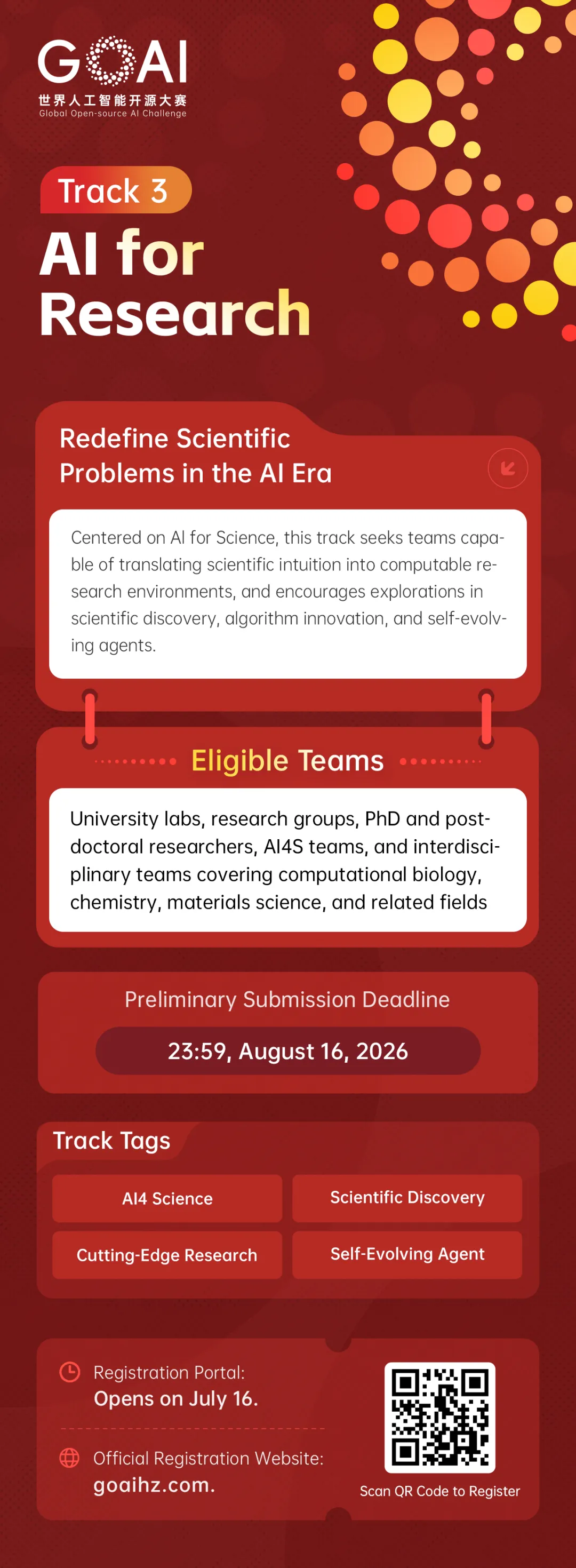
Long press to scan the QR code and register immediately
A total prize pool of 5 million RMB awaits challengers (Competition Registration QR Code)

Scan the QR Code to add GOAI Assistant
Your exclusive competition guide is online(GOAI Assistant QR Code)